
We’ve told the story of our origins many times: The Rev. Don Eddy rescued a truckload of perfectly good carrots from being dumped in a landfill because the farmer had no market for them. Rev. Eddy brought the carrots to community members who were struggling to feed their families.
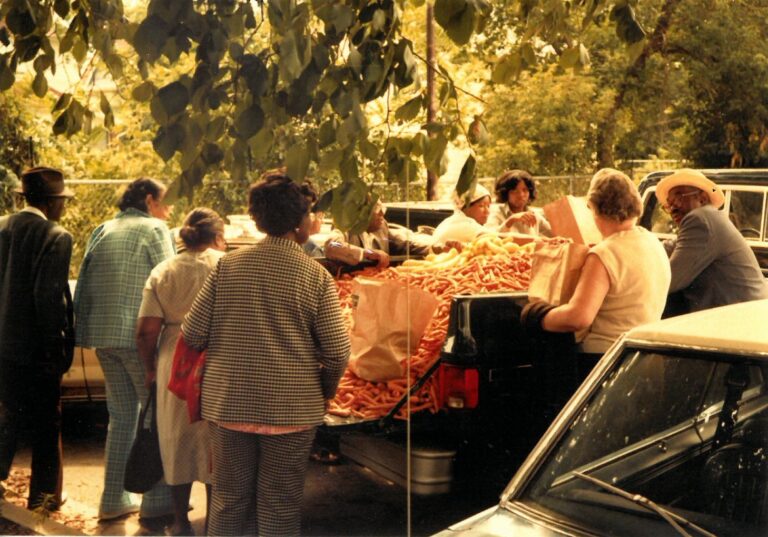
After 45 years, the reclamation of good food to help our neighbors is still at the heart and soul of what we do.
In 2025, our intervention redirected 15,075,950 pounds of food from landfills to support countless neighbors across West Michigan and the Upper Peninsula. Food donations accounted for half of the food we distributed in 2025.
In a world where food waste is still a major issue, we’re honored to be part of the solution. Food waste accounts for 8% of global carbon emissions. The Michigan Food Waste Roadmap reports that food waste is the most common material currently disposed of in Michigan’s landfills, accounting for 950,000 to 1.5 million tons.
This includes a large portion of surplus food. As defined by ReFed, a leading food waste nonprofit, surplus food is considered “all food that goes unsold or unused by a business or that goes uneaten at home.” Eighty percent are perishables like “fruits and vegetables, meats, prepared fresh deli items, seafood, milk and dairy, and some grain products such as bread and bakery items.”
Food packaging waste
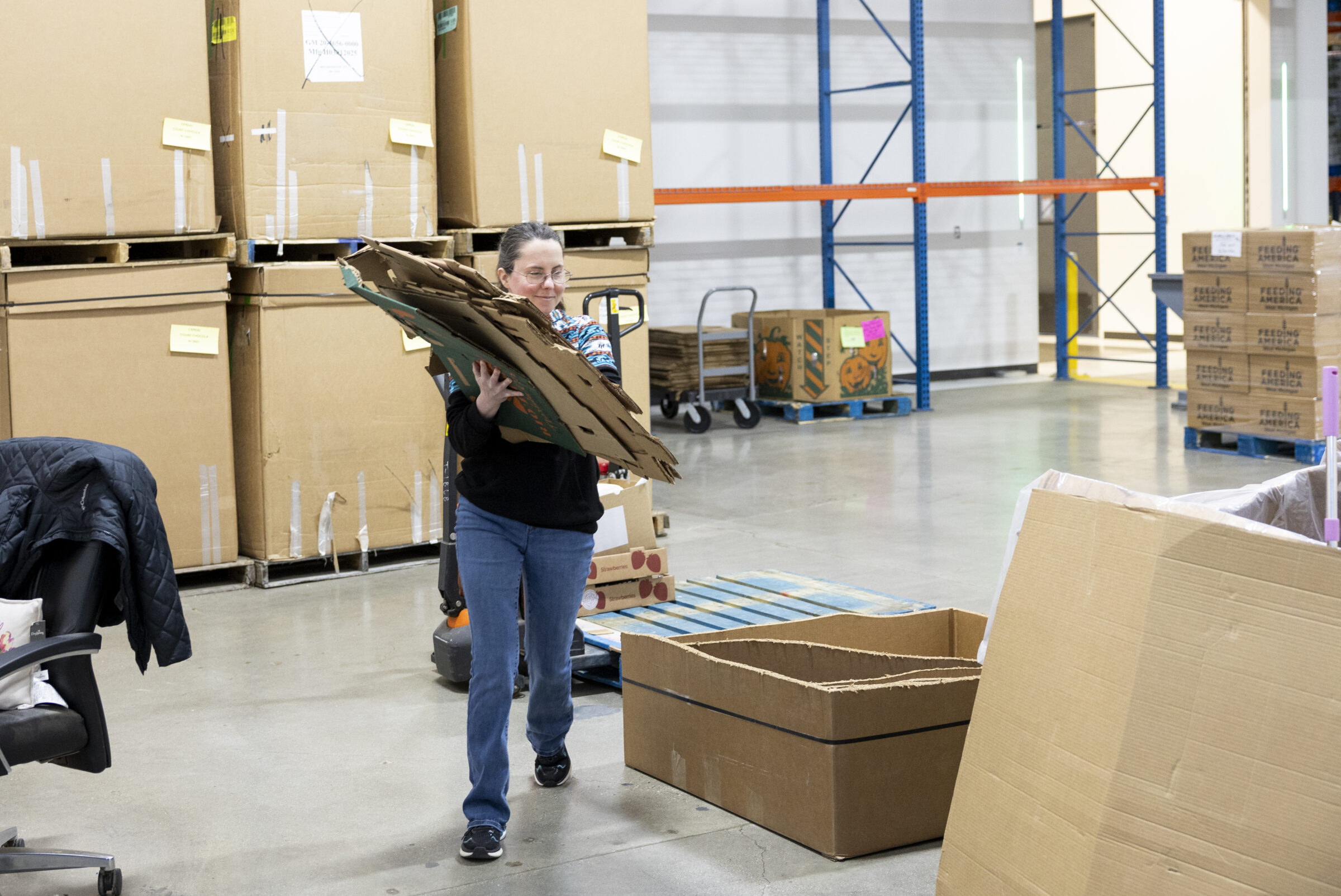
Because most food comes to us in boxes, we recycle an average of 200,000 pounds of cardboard yearly. That’s why it’s important for us to have a proper recycling process to deal with this volume of food packaging. Heather, the food bank’s recycling processor, dedicates much of her time to breaking down that cardboard and recycling it properly in our cardboard compactor. We partner with a local vendor called Clean Planet Recycling, which picks up the recycling when our compactor is full.
Our plastic wrap waste is also recycled. Our team collects the plastic wrap while unloading pallets. Once we have enough to send back to Meijer, staff from the retailer come to the warehouse to pick it up for recycling.
Transportation efficiencies reduce diesel emissions
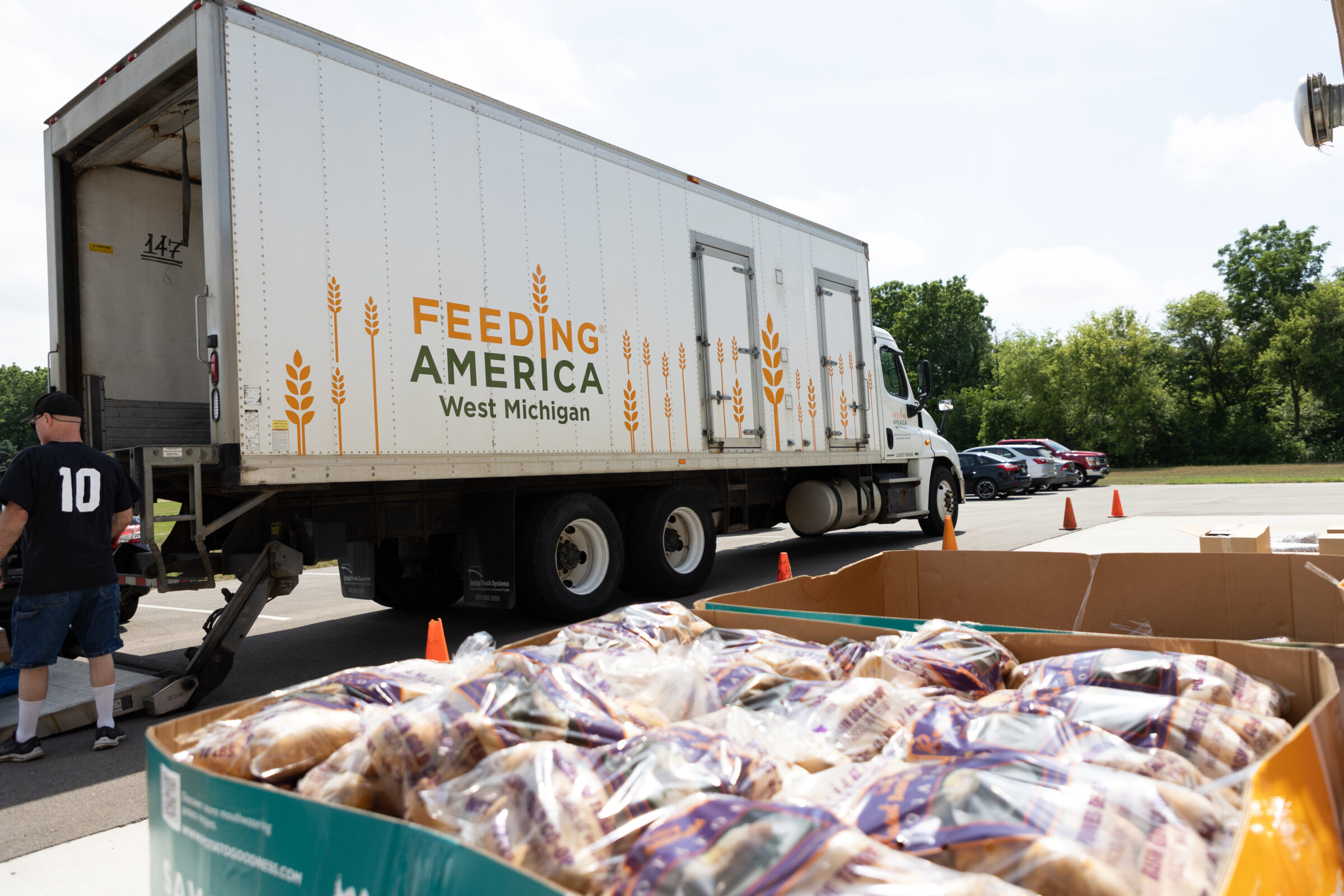
Our truck fleet covers at least 500,000 miles each year to get nutritious food to our neighbors. We strive to make the most out of every trip. This means, whenever possible, Feeding America West Michigan drivers will backhaul products from local producers after they drop off food at our agency partners.
For example, we’ve been partnering with Marker Farms, a 111-year-old family-owned-and-operated potato farm, for 15 years. Marker Farms donates their number 2 or unclassified potatoes to us. These number 2 potatoes are as nutritious as number 1 potatoes, but may be oddly shaped or too large to sell to retailers.
Marker Farms donates those potatoes, nearly 100,000 pounds of them in 2025 alone, free of charge, so the potatoes can go to communities instead of landfills. During the appropriate times of year, when one of our drivers makes the trip to our affiliate food bank, Manna Food Project, the driver also swings by Marker Farms on the way back to pick up those donations.
John Marker, a third-generation farmer, is happy to be a part of the arrangement for everything it does to feed neighbors and prevent the waste of good food.
“I like seeing my product being used by people,” he said. “It helps everybody else out. I enjoy donating. We don’t get money for what we donate to Feeding America. It’s free. I don’t mind that at all. There should be more of that throughout our nation. Instead of stuff going to landfills.”
John adds that as agricultural producers, Marker Farms feels a strong responsibility for the community.
“Every community needs that,” he says. “People have hardships, they can’t feed their family, feed their children. It’s important that there are places and options for them. We’re always donating and trying to support the community, and we’ve been here for 111 years. People look up to us as providers, and I enjoy being able to offer something to them.”
This Earth Day, we continue to honor our roots and our partners who share our values. We continue to honor the practices that give us the opportunity to serve our neighbors and our planet in so many thoughtful ways. We thank our community partners who help us accomplish this. As we work to end hunger in our 40-county service area, we are also always striving to improve how we can make a difference.